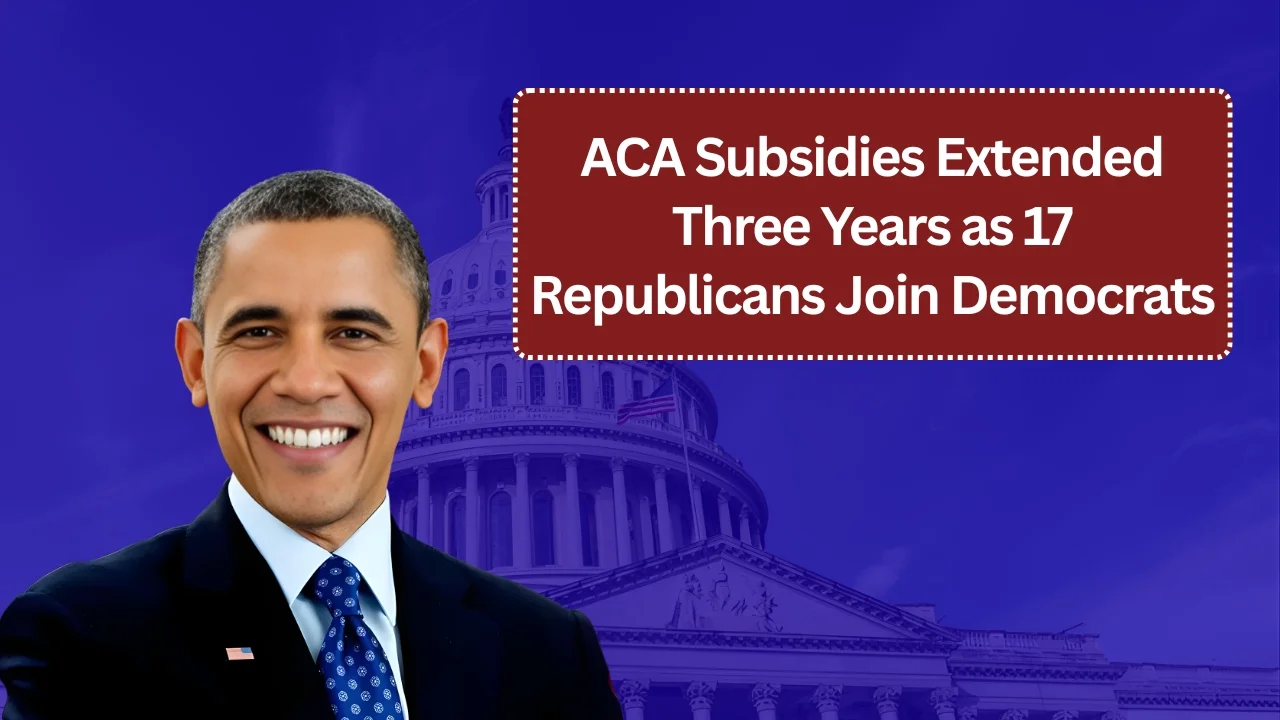
The U.S. House of Representatives took a rare bipartisan step this week by passing legislation to extend federal health insurance subsidies under the Affordable Care Act commonly known as Obamacare for three more years. The bill, approved 230–196, was backed by all Democrats and 17 Republican members of Congress, defying the leadership of their own party.

The enhanced subsidies are designed to help millions of Americans keep health insurance premiums affordable through the federal marketplace. They expired at the end of 2025, leading to a potential sharp increase in costs for enrollees. The House action now heads to the Senate, where its prospects are uncertain.
This rare cross-party vote highlights growing divisions within the Republican Party over health care and rising public concern about insurance affordability. It also sets up a high-stakes political issue ahead of the 2026 midterm elections.

ACA Subsidies Extended Three Years as 17 Republicans Join Democrats
The subsidies in question officially called Enhanced Premium Tax Credits were first expanded under the American Rescue Plan Act of 2021 to make health insurance more affordable during and after the COVID-19 pandemic. Democrats later extended these enhanced credits through the Inflation Reduction Act, which covered them through 2025.
Without congressional action, these subsidies were set to expire, meaning millions of Americans could see their health insurance premiums jump or coverage become unaffordable. Health policy experts had warned that termination of the enhanced credits could lead to dramatic premium increases and lower insurance enrollment across the country.

Republican leaders have long opposed the subsidies, arguing they increase federal spending and create inefficiencies in the health care system. Many GOP members also seek broader reforms to health care policy rather than a straight extension of existing tax credits.
Republicans Joining Democrats
On January 8, 2026, the House approved a bill primarily led by House Democrats to extend the enhanced Affordable Care Act subsidies for three years. The measure passed 230–196 after enough Republican members joined every Democrat in favor of the bill.

Key Vote Details:
- Total votes in favor: 230
- Opposed: 196
- Republican defectors: 17 supported the bill
The defection of these 17 Republicans marked a significant break with House Republican leadership and reflected pressure from voters facing rising health insurance costs.

Supporters of the extension say it would:
- Provide cost relief to millions of Americans shopping on the ACA marketplace
- Prevent significant premium hikes next year
- Stabilize coverage ahead of the midterm elections
Opponents including Speaker of the House Mike Johnson and many Senate Republicansargue the measure is fiscally irresponsible and does not include reforms to address perceived fraud and inefficiencies within the ACA marketplace.
What the Bill Does?
| Provision | Current Status | Change Under Bill |
|---|---|---|
| Enhanced ACA Subsidies | Expired end of 2025 | Extended through 2029 |
| Coverage Affordable Premiums | At risk of rising | Stabilized for enrollees |
| Bipartisan Support | Limited | 17 GOP supporters |
Expert Insight & Commentary
Health policy analysts say the bipartisan vote underscores widespread concern among lawmakers about rising health care costs.
Dr. Elena Rodriguez, Senior Fellow at the Health Policy Institute, said:
“The expiration of these subsidies would have meant significantly higher premiums for millions of Americans. The bipartisan nature of this vote reflects concern that affordability is now a central issue for voters across party lines.”
Professor Michael Tanner, health policy expert at George Mason University, noted:
“Even though extending subsidies may not be fiscally conservative, the political and social implications of letting them lapse especially without a clear alternative are substantial.”
Former Representative and GOP strategist Elaine Maxwell added:
“Moderate Republicans in competitive districts are feeling the pressure from constituents who don’t want to see higher premiums or loss of coverage and that’s affecting how they’re voting.”
Impact & Implications
If signed into law, the three-year extension would protect subsidies for an estimated 20–24 million Americans who rely on the ACA marketplace to keep premiums affordable. This would likely prevent significant increases in monthly health care costs for many households.
Politically, the bill highlights fractures within the GOP, particularly between hard-line conservatives who oppose the subsidies and moderates representing swing districts who are more receptive to extension. This dynamic could shape legislative strategy and campaign messaging heading into the 2026 midterms.
However, the bill’s future is uncertain. The Senate has a Republican majority, and similar extensions have previously failed to secure the 60 votes needed to overcome a filibuster. A separate Republican-led idea proposes a shorter two-year extension combined with other reforms, but consensus has yet to emerge.
Final Thoughts
The House’s approval of a three-year extension of Obamacare subsidies represents one of the most significant bipartisan votes on health care in recent years. It reflects pressure from constituents facing higher insurance costs and underscores deep policy debates in Washington over the future of the Affordable Care Act and federal health spending.
The bill now moves to the Senate, where its prospects are mixed. Senate leaders will need to decide whether to pursue the same three-year extension, negotiate a compromise, or propose alternative health care reforms. Meanwhile, millions of Americans await clarity on how much they will pay for health insurance in the coming years.
FAQs
What are Obamacare subsidies?
They are federal tax credits that lower the cost of health insurance premiums for people who buy coverage through the Affordable Care Act marketplace.
Who benefits from the extension?
Millions of low- and middle-income Americans who currently receive enhanced subsidies to reduce their monthly health insurance costs.
Why did some Republicans support the bill?
Moderate Republicans, particularly those in competitive districts, cited concerns over rising healthcare costs for their constituents.
What happens next?
The bill now goes to the Senate, where its passage is uncertain without bipartisan support or changes to the proposal.
How long would the subsidies be extended?
The House bill proposes a three-year extension, through 2029.